
How does the questionnaire for an structure expert judgment elicitation look like?#
A questionnaire for an elicitation using Cooke’s method contains two types of questions:
Seed or calibration questions. Questions whose answer is or will be known by the analyst. For instance, if I am interested in air temperature, I might ask about the maximum daily temperature next Saturday. I might also want to use data from field or laboratory campaigns that are unknown by the experts.
Questions of interest. Questions whose answer is unknown and are the main outcome of the elicitation: the variables we want to quantify.
For each question, the expert is asked to give some percentiles, typically three: 5%, 50%, and 95%. From now on, we are going to assume that these three percentiles are elicited but note that it can be extended to a higher number of percentiles.
Recall that 5% percentile represents the realization of the random variable (values) whose non-exceedance probability is 0.05. Therefore, the 5% percentile represents the quantity below which the expert thinks it is very unlikely to find the realization of the random variable. The 95% represents then the quantity above which the expert thinks it is very unlikely to find the realization of the random variable.
Looking at the responses of a questionnaire#
In Fig. 81, the results for 4 seed questions are shown for 5 experts. There we can already start identifying some things. For instance, expert A is the one with the largest uncertainty for all the questions, as the distance between the 5th and the 95th percentile are the largest. On the other hand, expert E seems to be the most confident in most of the questions, despite for the question ‘Question Overrun_fatal’. The expert could have been overconfident in the other questions.
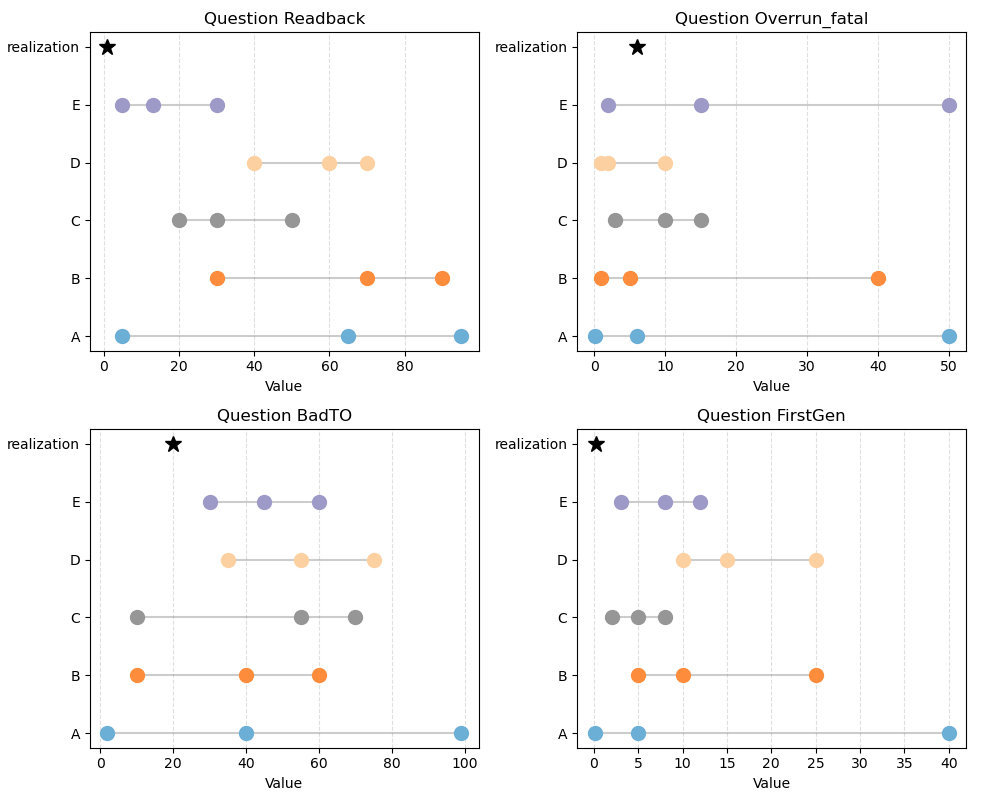
Fig. 81 Example of 4 seed questions with 5 experts (A, B, C, D, E). Each panel represents a seed question. The dots represent the 5th, 50th and 95th percentiles given by the expert.#